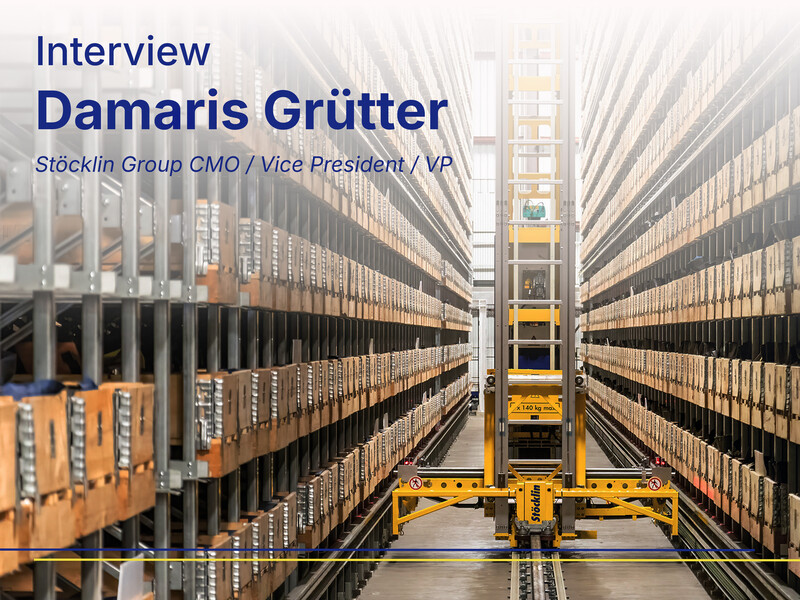
Interview with Damaris Grütter, Group CMO / Vice President / VP and Managing Director of Stöcklin Logistics Inc.
For me, resilience becomes apparent the moment something doesn’t go according to plan. How quickly can a company react when a supplier fails, key components are missing, or market conditions change fundamentally? And can it continue to fulfill its obligations to customers and employees in the process?
Resilience, therefore, does not mean predicting every crisis. It means understanding dependencies and creating structures that give us room to maneuver even under changing conditions.
At Stöcklin, our high level of vertical integration helps us achieve this. With in-house engineering, our own production facilities, and expertise in software and services, we possess essential capabilities within the company. This enables us to further develop technical solutions on our own and explore different options when difficulties arise. Of course, we are not entirely independent of external partners. We must also continuously develop and safeguard our own capabilities.
As an internationally active family-owned business, we combine short decision-making processes with a long-term perspective. We can ask ourselves which investments will make us stronger in five or ten years, rather than focusing exclusively on short-term results. This explicitly includes financial discipline: Only a financially sound company can take on responsibility in the long term.
“To me, thinking long-term means investing today in the capabilities that will keep us capable of acting tomorrow.”
Our project business also requires a conscious approach to risk management. A contract often spans several years. During this time, material prices, delivery terms, and customer requirements can change. That’s why, right from the project evaluation and contract drafting stages, we must carefully assess which risks we can assume and how we will manage them. Not every project is the right one at any cost.
In doing so, we draw on decades of experience. What’s crucial, however, is not just gathering experience but learning from it. Which dependencies did we underestimate? Which decisions proved successful? And what do we need to change for the next project?
For our customers, resilience becomes a reality when we can continue to support them long-term even after commissioning—with service, upgrades, and the further development of their systems. They invest in systems that are expected to function reliably for decades. Our own ability to act is therefore part of the assurance they expect from this investment.
There is no such thing as a perfect, permanent balance. The framework conditions change, and with them, the type of safeguards that make sense also changes. The key question for us is: What does preparation cost us—and what would a failure cost us?
During the pandemic, we saw just how severely a shortage of components can disrupt a project. Building up additional inventory afterward gave us greater security. At the same time, it became clear that not every item of inventory was needed in the same quantity on a permanent basis. For us, too, inventory ties up capital. With electronic components in particular, there’s the added issue that they can become technologically obsolete.
For me, the conclusion is that reserves must be reviewed regularly. What made sense during an acute shortage must be reevaluated under changed conditions.
“Resilience doesn’t mean building up reserves everywhere. It means being prepared in the right places.”
The number of suppliers alone says little about actual security. Multiple suppliers may depend on the same production facility or the same upstream supply chain. Conversely, a few reliable partners with transparent supply chains and coordinated alternatives can form a sustainable foundation. We need to understand where the dependencies actually lie.
That is why we do not treat resilience as a blanket surcharge on every budget, but rather as a targeted investment in particularly critical areas. This involves clear priorities: Where do we need an alternative? Where is it worth maintaining inventory? And what risks can we consciously accept?
These decisions remain a leadership responsibility. Those who focus solely on the lowest purchase price may underestimate the costs of a shutdown. Conversely, those who seek to hedge against every conceivable uncertainty tie up resources that are then lacking for innovation and further development. The goal is to secure the room for maneuver that the company actually needs.

We must be prepared for the fact that conditions in international business can change even within ongoing projects. This poses a significant challenge, especially for European industrial companies with long project timelines. Our response should be to incorporate these changes into our planning and to expand our options for action early on.
From my experience with business in the U.S., I know how important timing is in this regard. Once a project has been technically defined, the materials ordered, and production well underway, it’s not easy to shift procurement to another market on short notice. Local sources of supply must be evaluated in advance—in terms of quality, availability, technical suitability, and cost.
“A local supply chain only becomes a safeguard when we know we can actually use it at the critical moment.”
For companies operating internationally, a local presence is therefore an important starting point. However, it is not enough on its own. What matters most is which skills, partners, and sourcing options are actually available locally. At Stöcklin, we also collaborate with local assembly and electrical specialists on our projects. This collaboration provides insight into the conditions in the respective market and helps us implement projects on-site.
At the same time, local sourcing is no guarantee of low costs or independence. A local supplier may itself rely on imported components. And if trade conditions change, local prices can rise as well. That’s why we need to look beyond the first tier of suppliers to understand where products are manufactured and what dependencies lie behind them.
For companies in Europe, I would conclude that they should make critical supply chains more transparent, identify suitable alternatives early on, and assess which value-added activities should reasonably take place in the respective target market. This can vary greatly depending on the product and project. Not every stage of production can be relocated, and not every relocation makes economic or environmental sense.
Contractual preparation is equally important. For multi-year projects, potential changes in tariffs and other framework conditions should be discussed with the customer early on, and their implications clearly defined. Transparency creates a better foundation for joint decisions here than waiting to discuss additional costs only after they have already arisen.
But we in Europe should also continue to develop our own strengths: engineering, industrial expertise, software, and the ability to support complex systems throughout their entire life cycle. Resilience also stems from offering services for which customers need us as a long-term partner.
For me, resilience goes hand in hand with sustainability. Both require thinking beyond the immediate price and the next set of results. What capabilities are we securing? What resources are we deploying? And which decisions will leave us room to maneuver in the future?
“We cannot control the external conditions. But we can influence how well prepared we are for them.”