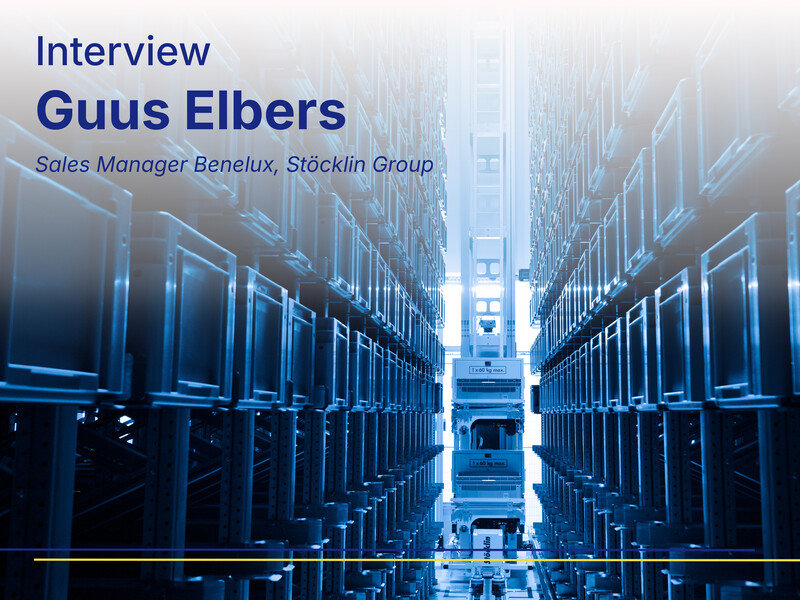
Interview with Guus Elbers, Sales Manager for Benelux, Stöcklin Group
We don’t believe in automation for automation’s sake. Our job is to understand the customer’s logistics processes and needs so we can determine where automation actually creates measurable added value. Sometimes the right answer is to automate immediately. Sometimes it involves first preparing the company and its processes for automation, rather than rushing into it. The key is that, when you automate, you have the right solution for your operations, requirements, and business case—not just for the present, but also for the company you want to lead in ten, fifteen, or even 20 years.
“We don’t believe in automation for automation’s sake. Our job is to understand the customer’s logistics needs in order to determine where automation creates measurable added value.”
How this plays out in each individual case depends on where a customer stands when they approach us: on the maturity of their automation plans, their requirements for innovation and future-readiness, and their current situation. For example, one of our customers is currently building a large book warehouse. In this case, it was clear from the start that automation would bring significant benefits.
There are three major mistakes that I encounter time and again.
First: automating the existing process instead of redesigning it. If you automate a poor process, you don’t eliminate its problems—you just make them happen faster. That’s why it’s important to us at the Stöcklin Group to develop the business case, understand the status quo, and outline a vision for the future. We sit down with the client, discuss the current figures, and define what the process should look like in an automated environment. We then conduct tests and simulations to identify where the potential for greater efficiency lies.
“If you automate a bad process, you don’t eliminate your problems—you just make them happen faster.”
The second mistake is optimizing for today’s volume rather than tomorrow’s business. That may sound obvious, but that is precisely why modularity, scalability, and expandability are indispensable today. It’s not enough to simply sell a system that delivers maximum capacity. It’s an investment in the future—which is why we always keep the future in mind when configuring a solution.
One of our most important customers in the Netherlands is a good example of how evolution—rather than radical revolution—is possible. We installed their high-bay warehouse in 2017—almost ten years ago. Since then, we’ve been working with them on additional projects and automating their operations step by step. Hopefully, an expansion of the high-bay warehouse will follow in the near future.
The Stöcklin Group sees itself as a partner that guides your company on the path to automation and delivers tailor-made solutions. This is exactly the role we want to play. Added to this are our long-term service and support offerings after installation—so you receive a complete package.
“As customers become increasingly enthusiastic about AI and robots, it’s important to remember: technology isn’t the actual goal.”
One final mistake I see companies making: they buy technology instead of a sustainable solution. Keeping this in mind is becoming increasingly important, because customers are easily captivated by robots and AI. But technology isn’t the actual goal. The real goal might be a 30% increase in throughput or fewer staff per shift—only once you know this true goal should you determine which technology can achieve it efficiently. So don’t start with the technology; start with the logistical challenge you want to solve.
Let me give you an example: Some of our customers repeatedly refer to our automated storage and retrieval systems as “robots.” I’ve corrected them several times so they don’t develop false expectations. But in their minds, they have a robot in their high-bay warehouse. That’s the result of their fascination with automation. It remains our responsibility—and that of experienced consultants—to ensure that the customer receives a customized, sustainable solution tailored to the reality of their business—even if they continue to call them “robots.”
Energy, sustainability, and the shortage of skilled workers.
Automation creates efficiency, but automated warehouses also consume energy. Customers will increasingly consider the overall energy footprint of their logistics operations, not just productivity. Energy-efficient drives, energy recovery systems, smart charging, and the reduction of unnecessary movements will become part of the investment decision. At Stöcklin, these are topics we address and discuss with our customers early in the sales process to ensure their expectations are met.
As far as labor availability is concerned, it’s not simply a matter of there not being enough people. Companies will increasingly face higher labor costs, an aging workforce, hard-to-fill warehouse positions, and pressure to make these positions more attractive. The question is: To what extent should operations depend on having enough staff available at the right time?
Automation means you’ll need fewer people to move goods, but you’ll still need people to operate the equipment, perform commissioning, and manage the processes. What if you can’t find the right people? What about seasonal peaks? Or sudden employee absences that need to be covered? To a certain extent, automation can help with staffing issues and increase your resilience in this area.
Nevertheless, these challenges will persist—and we’ll continue working to find new ways to solve them or at least mitigate them.


