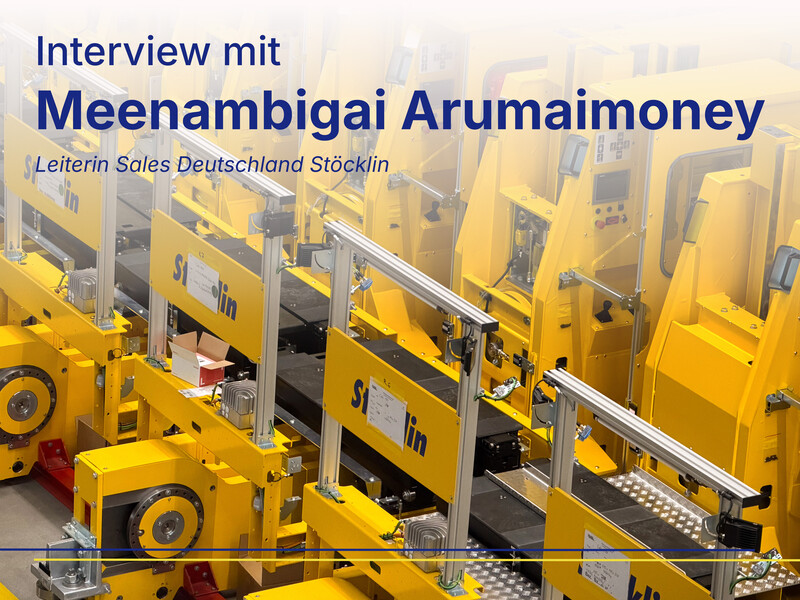
Interview with Meena Arumaimoney, Head of Sales Germany, Stöcklin Group
Meena Arumaimoney helps companies optimize and further develop their intralogistics. In this interview, she discusses when automation truly adds value, what mistakes make investments unnecessarily expensive, and why future-proofing today involves far more than simply choosing the right technology.
I wouldn’t start with the technology, but rather with the question of what the customer wants to achieve. Is it about higher throughput, more consistent quality, greater availability, better ergonomics, or dealing with the shortage of skilled workers? Only once the goals and current processes are clear can you make a sound decision about where automation creates real added value.
For me, automation is not an end in itself. Especially when dealing with a wide variety of products, packaging, or variants, it can be more cost-effective to selectively automate recurring and standardizable processes while flexibly handling deliberate exceptions. What matters is not the maximum possible degree of automation, but the right balance between performance, flexibility, and cost-effectiveness.
“Sometimes partial automation is the right step; other times, a more comprehensive solution is needed. What’s important is that the decision is well-reasoned and sustainable in the long term.”
This also involves a realistic assessment of the total investment. It’s not just the purchase price that matters, but also operation, maintenance, availability, and the question of how requirements might change in the coming years. A solution must work today while also offering sufficient room for growth, changing volumes, and new processes.
Sometimes partial automation is the right step; other times, a more comprehensive solution is needed. In my experience, the best solution emerges when we have an open discussion with the customer about goals, framework conditions, and limitations.
A common mistake is committing to a specific technical solution too early. If the technology is already in place before processes, performance requirements, and strategic goals have been clearly defined, attempts are made later to adapt the process to the technology. In my view, it has to be exactly the other way around: First, we understand the process and the requirements; then we develop the appropriate overall concept and select the suitable technology.
It’s just as critical not to plan solely for today’s needs. Order structures, volumes, and customer requirements change. That’s why scalability, performance reserves, and expandability must be factored in from the very beginning—without unnecessarily oversizing a system. To me, good planning means consciously sizing technical and economic reserves.
“We look at the entire process chain and translate the customer’s requirements into a solution that is technically, economically, and organizationally robust.”
Another key consideration is the organization surrounding the system. Existing manual processes cannot always be transferred one-to-one into an automated environment. Material flows, interfaces, load carriers, data, and responsibilities must be perfectly coordinated. It is equally important to involve employees early on. Those who will later work with the system must understand why processes are changing and how the new solution works in everyday operations.
This is precisely where I see our responsibility as a general contractor. We examine the entire process chain and translate the customer’s requirements into a solution that is technically, economically, and organizationally robust. For us, quality is an essential component of long-term cost-effectiveness. Our products are developed in-house and largely manufactured in Switzerland. Through our in-house manufacturing and testing—including the FAT (Factory Acceptance Test), which we conduct in the presence of the client—we have direct influence over quality, reliability, and the coordination of components.
At Stöcklin, sales therefore means more than just acquiring and closing a project. We must clearly communicate early on what a solution can achieve, what changes it will require on the customer’s end, and how it can be further developed over many years. It is precisely this clarity that builds trust and prevents disappointment later on.
The pressure to change is increasing significantly. Customers expect shorter delivery times and high availability, while at the same time product ranges, packaging, and volumes are becoming more volatile. Added to this are a shortage of skilled workers and cost pressures. Intralogistics must therefore not only be efficient but, above all, adaptable and robust.
Digitalization and artificial intelligence will play an increasingly important role in this regard. Operational data can be used to identify opportunities for optimization and make proactive decisions. For me, however, the most important thing is that the foundation is right: clear processes, reliable data, clean interfaces, and a stable system architecture. AI can support good processes—it does not replace intelligent process design.
“Future-proof intralogistics does not begin with a technology decision. It begins with an understanding of what the customer needs today—and what they must be able to achieve tomorrow.”
As connectivity increases, so does the importance of cybersecurity. This is not a task that a supplier or operator can solve alone. Operators, integrators, IT teams, and other partners must clarify responsibilities and interfaces early on. Security must be taken into account throughout the entire lifecycle of the system.
Regulatory requirements are also gaining in importance. The EU Machinery Regulation (EU) 2023/1230 takes effect on January 20, 2027. For projects with a corresponding timeframe, these requirements must therefore be taken into account in a timely manner during planning, design, documentation, and conformity assessment.
And finally, sustainability remains a central issue—not only from an environmental perspective, but also from an economic one. Energy consumption, durability, maintainability, and the ability to adapt or expand a system later on influence the total costs over many years. For me, future-proof intralogistics is achieved when processes, technology, people, data, safety, quality, and cost-effectiveness are considered together from the very beginning.